

Michigan Botanical Society,
Southwestern Chapter
The Southwestern Chapter, based in Kalamazoo, serves amateur and professional botanists and nature enthusiasts in the southwest corner of Michigan.
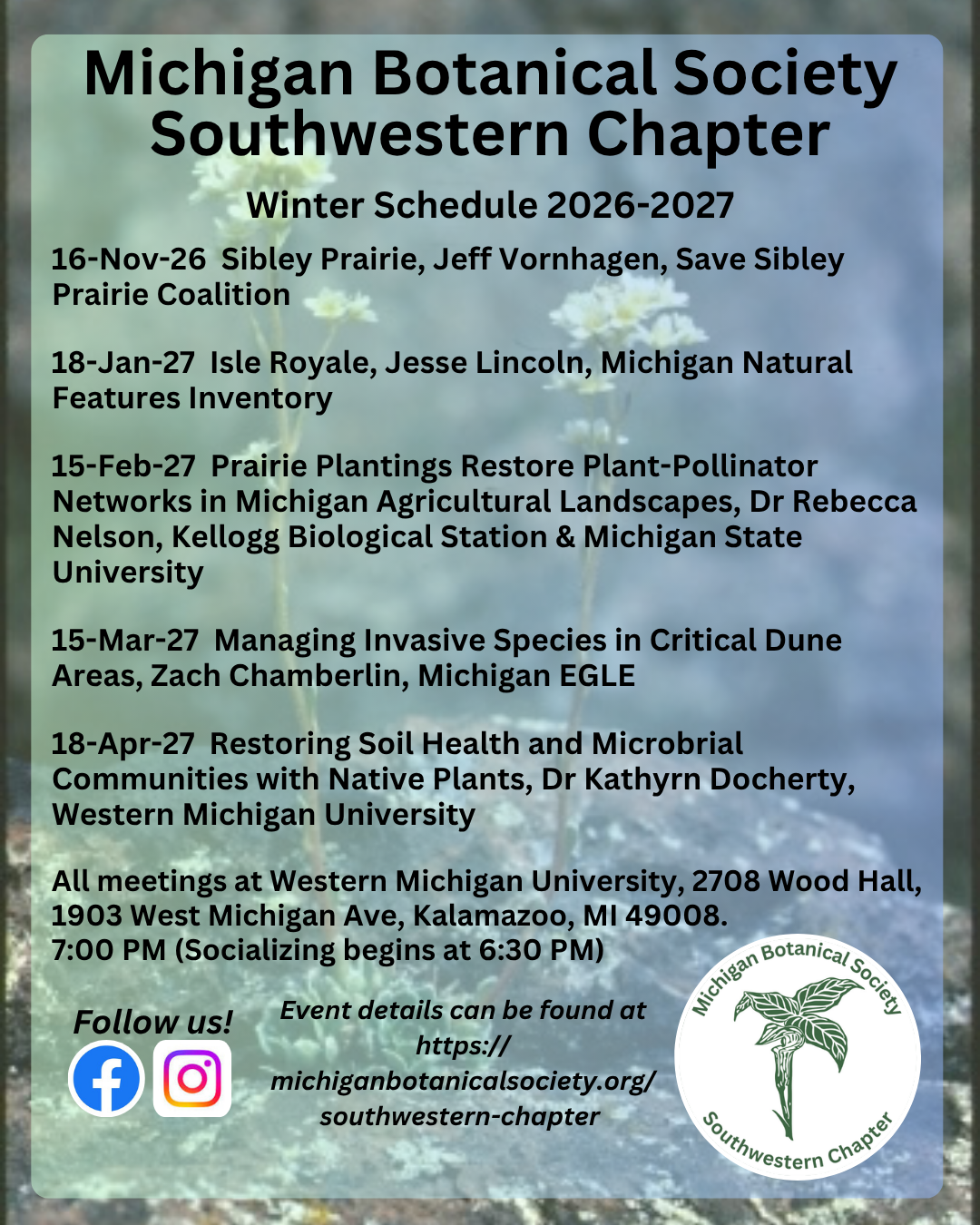
2026-2027 Winter Schedule

Field Trips
During the warmer months, the Southwestern Chapter organizes field trips to some of the most spectacular natural sites in southwestern Michigan, many of which are not open to the public.


Meetings
Meetings occur in November, January, February, March & April, on the 3rd Monday of the month at the Western Michigan University, 2708 Wood Hall, 1903 West Michigan Ave, Kalamazoo, MI 49009. Socializing begins at 6:30 PM and the presentation starts at 7:00 PM.

Membership
As members, you may attend field trips to some of the most spectacular natural sites in southwestern Michigan, many of which are not open to the public. During colder weather, we have monthly meetings featuring presentations on botanical, ecological and conservation subjects. Members also receive a subscribe to the peer-reviewed journal, The Great Lakes Botanist, a Journal of North American Botany, which is published twice a year and a subscription to the spring and fall newsletter Arisaema.
Follow the Southwestern Chapter


Join the Southwestern Chapter
Use this link for the easy online payment. A small convenience fee of 3.5% will be added to your payment through the Cheddar-Up platform.

2026 Southwestern Chapter Officers
Officers
President: Joe Trapp
Vice President: Michael Dombos
Secretary : Abbie Bristol
Treasurer: Chuck Jordan
Director at Large
Connor Nussbaum
Useful Links
Michigan Botanical Society
The Great Lakes Botanist https://journals.publishing.umich.edu/glbot/
The Michigan Botanist (1962-2006) https://catalog.hathitrust.org/Record/000497763
Winter Wildflowers http://www-personal.umich.edu/~ldnum/WinterWildflowers%281973%29dblpgs.pdf
University of Michigan Herbarium https://michiganflora.net/home.aspx
State of Michigan
Michigan Natural Features Inventory (MNFI) https://mnfi.anr.msu.edu/services
Michigan Department of Natural Resources (DNR) https://www.michigan.gov/dnr
Michigan Department of Environment, Great Lakes and Energy (EGLE) https://www.michigan.gov/egle
MSU Extension Service https://www.canr.msu.edu/outreach/
W.K. Kellogg Biological Station (KBS) https://www.kbs.msu.edu/
Kellogg Bird Sanctuary http://birdsanctuary.kbs.msu.edu/
Conservation
Southwest Michigan Land Conservancy (SWMLC) https://swmlc.org/
Michigan Nature Association (MNA) https://www.michigannature.org/
Chikaming Open Lands https://chikamingopenlands.org/
The Nature Conservancy https://www.nature.org/en-us/
Audubon Society of Kalamazoo https://kalamazooaudubon.org/
Michigan Audubon https://www.michiganaudubon.org/
Land Conservancy of West Michigan https://naturenearby.org/
Michigan Wetlands Association https://miwetlands.org/
Michigan Prescribed Fire Council https://www.firecouncil.org/
Wild Flower Association of Michigan https://wildflowersmich.org/
Michigan Lakes and Stream Association (MLSA) https://mymlsa.org/
Kalamazoo River Watershed Council (KRWC) https://kalamazooriver.org/
Conservation Districts
Michigan Association of Conservation Districts https://www.macd.org/
Allegan Conservation District https://www.allegancd.org/
Barry Conservation District https://www.barrycd.org/
Berrien Conservation District https://www.berriencd.org/
Calhoun Conservation District https://www.calhouncd.org/
Cass Conservation District https://cassccdistrict.org/
Kalamazoo Conservation District https://www.kalamazooconservation.org/
St Joseph Conservation District https://stjoecountycd.com/
Van Buren Conservation District https://vanburencd.org/
Invasive Species & Cooperative Invasive Species Management Areas (CISMA)
Michigan Invasive Species https://www.michigan.gov/invasives/take-action/local-resources/view-cisma-locations-as-a-list
Midwest Invasive Species Information Network (MISIN) https://www.misin.msu.edu/
Barry, Calhoun & Kalamazoo CISMA contact bckcisma@gmail.com
SW x SW Corner CISMA https://vanburencd.org/invasive-species/
Southern Michigan IST https://stjoecountycd.com/smist-cisma#:~:text=Southern%20Michigan%20Invasive%20Species%20Team,a%20multitude%20of%20regional%20partners.
West Michigan CISMA https://wmconservation.net/
Nature Centers
Kalamazoo Nature Center https://naturecenter.org/
Pierce Cedar Creek Institute https://cedarcreekinstitute.org/
Whitehouse Nature Center https://www.albion.edu/about/our-campus/whitehouse-nature-center/
Sarett Nature Center https://sarett.org/
Native Plants & Gardens
Kalamazoo Area Wild Ones (KAWO) https://kalamazoo.wildones.org/
Hidden Savanna Nursery https://www.hiddensavanna.com/
Adjacent
Michigan Entomological Society https://www.michentsoc.org/
Indiana Native Plant Society https://indiananativeplants.org/
